
Hialeah Gardens Directory Collections
Hialeah Gardens incorporated in 1948, so there is no long city-only shelf reaching into the early twentieth century. The strongest verified shelf is the Miami-Dade Public Library System Special Collections at Main Library. Its Genealogy Collection holds more than 27,000 bound works and 35,000 microforms, including Miami-Dade city and telephone directories. Most physical items are used in the library. The catalog does not publish an exact year-by-year run, so ask genealogy staff to confirm a volume before treating any year as available.
| Collection | Years | Where Held | Access |
|---|---|---|---|
| City of Miami Directory | 1924 volume verified | MDPLS Main Library | Helen Muir Florida Collection |
| Miami-Dade city and telephone directories | Exact run not posted | MDPLS Genealogy Collection | Primarily in-library use |
| Florida state censuses | 1885, 1935, 1945 | MDPLS genealogy holdings | Microform and databases |
| Federal census schedules | 1790 through 1950 public | National Archives | Free online research |
| Surname files | Some material from the 1800s | MDPLS digital genealogy collection | Free online browse |
The table separates verified coverage from material that still needs a shelf check. A Miami directory can give useful regional context, but it does not prove that every Hialeah Gardens household appeared. People could be omitted, listed under a variant spelling, or recorded between moves. The MDPLS Genealogy Collection adds surname files, clippings, trees, and newsletters, though each item must be judged by its original source.
The MDPLS Special Collections page is the best first check for collection access and staff help.
Hialeah Gardens After Incorporation
The city was incorporated on December 1, 1948. That makes the released 1950 federal census the first decennial schedule searchable under the Hialeah Gardens municipal identity. The 1950 Census search accepts a name, location, or enumeration district. It can show a household at the date of enumeration, along with location, relationships, and occupations. It does not establish continuous residence before or after that day.
Machine indexing can miss Spanish compound surnames, accents, and hard handwriting. If a name search fails, narrow to Florida and Miami-Dade, identify the enumeration district, and browse the pages. Compare any match with an address from a city directory or deed. Under the 72-year access rule explained by the National Archives census guide, the 1960 schedules are expected to open in 2032.
Note: A missing name in an OCR index calls for page browsing, not a quick conclusion that the household was absent.
Inside the Miami-Dade Genealogy Shelf
The scale of Main Library's collection matters because Hialeah Gardens research crosses municipal lines and older place labels. Its books and microforms include Florida censuses, telephone indexes, passenger lists, First World War draft cards, and Miami air-arrival records from 1930 through 1942. Licensed tools include Ancestry Library Edition. Most physical sources require an in-person visit, while librarians provide onsite and electronic reference help.
This is also the right place to resolve the largest research gap: no official catalog page exposed a verified Hialeah Gardens-only publisher and year run. Ask for Miami-Dade city directories and telephone books covering the target decade, then inspect the title page and abbreviation key. Record the publisher, edition year, and call information from the item itself. That cautious method is more useful than assigning a famous directory brand without proof.
A Miami-Dade Directory Method
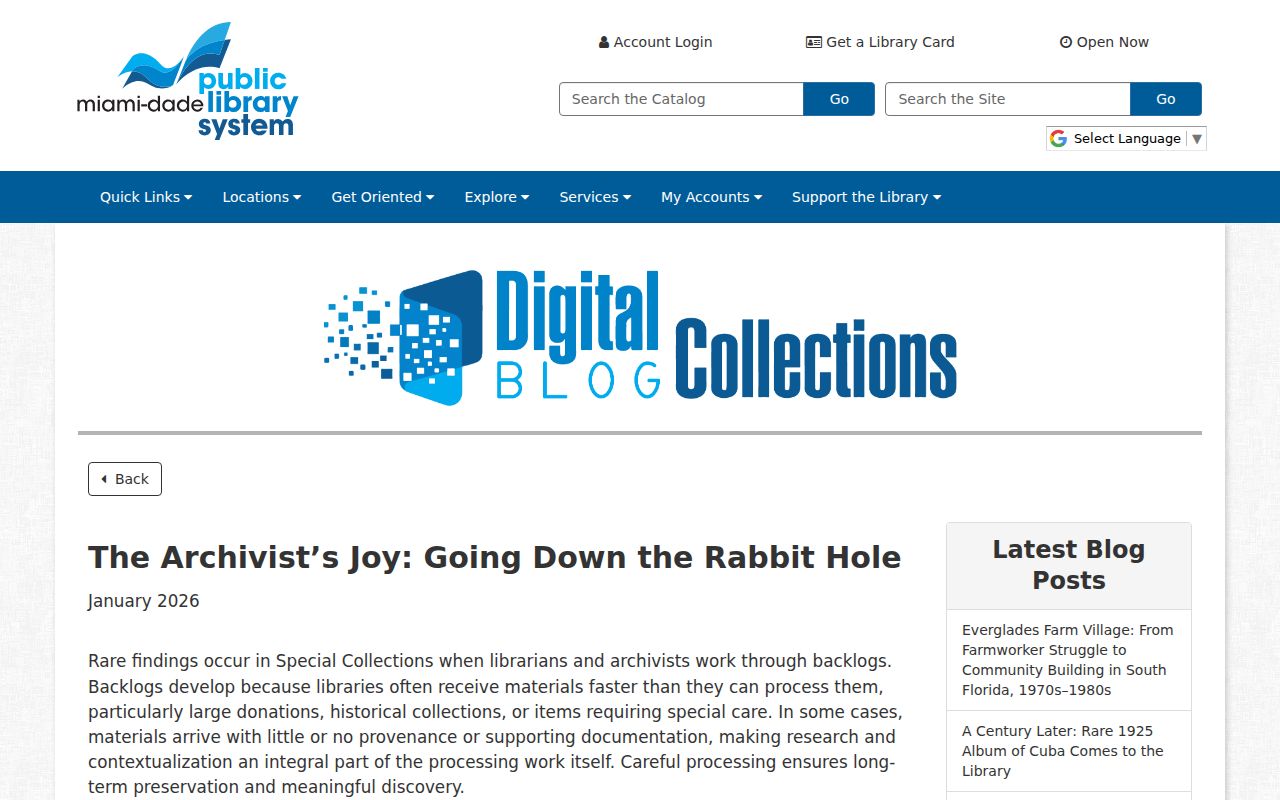
A January 2026 MDPLS research story shows how librarians traced the Miami Anglers Club with the 1924 City of Miami Directory, a newspaper item dated January 8, 1923, and photographs by Gleason Waite Romer. The sources together established more than a lone name hit: they tied an organization to a place and followed an address change.
The library's illustrated account lets a researcher see the kind of cross-source work behind that conclusion.
Use the same method for Hialeah Gardens city directories. Transcribe the listing, note the edition date, and seek a second source near the same year. A census page, deed, newspaper notice, photograph, or surname file may confirm the address or show why it changed. Conflicts should remain visible in research notes. They often reflect different publication dates rather than a bad record.
Read Hialeah Gardens Directory Entries
Read only the fields printed in the volume. No sample Hialeah Gardens residential entry was exposed online during research, so the safest inventory is a checklist for use at the shelf. Photograph the title page and abbreviation key first. Then transcribe the line exactly, including punctuation and marks. An occupation or spouse notation may help distinguish two people with the same name, but it still reflects the publisher's convention for that edition.
| Name | Surname and given name as printed; preserve initials and spelling |
|---|---|
| Spouse | A name may appear in parentheses if that edition uses the form |
| Work | Occupation and sometimes employer, only when printed |
| Address | Home or business address as distinguished by the key |
| Status marks | Possible widow, owner, renter, or telephone notation defined by that volume |
- Criss-cross directory
- A later directory arranged by street and house number instead of surname.
- Householder index
- A list focused on the person identified as head of a household, not every occupant.
- Abbreviation key
- The publisher's legend for short forms and symbols; it controls how each entry should be read.
Do not fill a blank field from expectation. An absent spouse, occupation, or ownership mark means the volume did not show it in that entry. It does not prove the underlying fact was absent.
Hialeah Gardens Maps and Photos
The University of Miami Special Collections can add place evidence that directory lines lack. Its Florida holdings include Model Land Company correspondence and plats from a firm founded in 1896, photographs and albums from the 1910s through the 1930s, 1926 hurricane images, Pan Am records from 1929 to 1991, postcards, maps, and oral histories. Researchers use the Kislak reading room by Aeon appointment made at least seven days ahead. Remote users may request a proxy-researcher list.
The Library of Congress Hialeah Sanborn set dates to 1958 and contains 96 sheets, with 93 images online. Its catalog title is Hialeah, not Hialeah Gardens. Check the index sheet against the exact address before claiming coverage. When it does cover the place, a fire-insurance map can show building form or use near a directory date, not who lived there.
Maps also help when a street name or subdivision label has shifted. Compare the directory spelling with the map index, then record the sheet number and map date. A building footprint can support the existence and use of a structure at that point in time. It cannot replace a named household source. Keep the map citation beside the directory citation so later readers can see what each item proves.
Florida Archives for Hialeah Gardens Directories
The Florida State Archives preserves state and county material that may supply context when a local directory trail stops. Search its catalog by a family name, place, organization, or record group, then confirm access with archival staff. The strongest results tend to come from a narrow date range and a known event rather than a broad resident query.
For Hialeah Gardens, older records may appear under Miami-Dade, Dade County, Hialeah, a subdivision name, or a legal description. Keep those labels in the search notes. The city name did not exist before incorporation, and a modern ZIP is not a sound key for an early collection. This shift in geographic terms is a common reason that a relevant item seems missing.
Trace Hialeah Gardens Family History
A sound family trail moves in small steps. Start with the most recent firm name-and-address pair, then work across neighboring directory years. Pair that evidence with a released census schedule and a source created for a different purpose. The method helps separate a true move from a spelling change or missed edition.
- Confirm the directory's title, publisher, and year before copying the person's entry.
- Search the next available editions under spelling variants and initials, noting each address change.
- Use a criss-cross section, if present, to check the address and nearby household names.
- Pair the directory evidence with the 1950 census or another released schedule near the same period.
- Test the result against a deed, surname file, newspaper item, photograph, or other independent source.
Disappearance from a city directory has several possible causes: a move, death, omission, an unlisted telephone, a renamed street, or a shift in how the publisher indexed the household. Do not choose one cause from silence alone. A modern address search belongs in the Hialeah Gardens street directory, while this historical workflow stays focused on dated books and schedules.