
Hialeah Gardens Lookup Sources
No single roll proves where a person lives. Miami-Dade County keeps most records that can confirm a Hialeah Gardens connection because the city is a municipality, not a separate records county. A useful resident lookup asks a narrow question of each source. The Property Appraiser ties an owner to a parcel. The Clerk ties named parties to deeds and cases. Elections confirms a registered voter's own record through an identity-gated tool, while public extracts follow separate rules.
| Record | What It Confirms | Where | Access |
|---|---|---|---|
| Property roll | Owner, situs, tax mailing address, folio | Property Appraiser | Free online search |
| Recorded deed | Transfer parties, legal parcel, date | Clerk Official Records | Web mostly from 1974; older library index |
| Court docket | Party role, filings, events, disposition | Miami-Dade Online Case Search | Public cases; closed matters absent |
| Voter record | Authenticated status, address, party, districts, activity | Voter Information | Name and birth date identity gate |
| Vital certificate | Birth, death, marriage, or dissolution event | Florida Vital Statistics | Eligibility and certification vary |
| Business or license | Dated role, status, and public contact fields | Sunbiz, DBPR, or MQA | Free public lookup |
Choose the first source from the fact already known. An address points to the property roll. A case number belongs at the Clerk. A marriage or death event belongs with Vital Statistics. Record the date and type of every address because a tax mailing address, business address, and parcel's physical address are not interchangeable.
Match Hialeah Gardens Records Twice
Common names are the main hazard in a Hialeah Gardens resident lookup. Search accents, hyphens, double surnames, initials, reversed order, and premarriage names. Local naming patterns make that care useful, but no demographic fact proves how one person writes a name. Keep conflicting candidates apart until two independent details agree.
- Write the full known name, variants, approximate age, last verified address, and date.
- Search the property roll by owner name. Copy the indexed owner, situs, mailing address, folio, exemption year, and last sale.
- Use the deed reference to check the named party and legal description in Official Records.
- Search a second index, such as a court docket, business report, license record, or public event certificate.
- Accept the match only when compatible names, dates, roles, or addresses align.
This method avoids turning a clue into a false claim. A grantee acquired an interest, not a full household. A business officer has an affiliation, not necessarily a home at the firm's address. If the goal expands from one person to an entire road, use the Hialeah Gardens directory by street for the address-led workflow.
Hialeah Gardens Owner Clues
The Miami-Dade Property Appraiser accepts an address, owner name, 13-digit folio, or subdivision. Results can show the indexed owner, tax mailing and situs addresses, legal description, sales history, parcel traits, values, exemptions, aerial imagery, and a building sketch when available. These fields make the roll a strong start, yet they do not list everyone at the home.
Key distinction. Situs means the parcel's physical address. Mailing means where tax correspondence goes, and the two may differ without error.
Try both forms of a hyphenated surname and join Mc or Mac forms when the owner search misses an expected result. Then carry the folio and legal description into the deed index. Those parcel keys are more stable than a person's mailing choice. Homestead exemption can support owner occupancy, but it still cannot identify each resident.
Read Hialeah Gardens Court Results
Hialeah Gardens cases are held by the Miami-Dade Clerk in Florida's Eleventh Judicial Circuit. The county search covers civil, family, probate, criminal, and traffic modes. Florida Courts Access can help discover dockets in participating jurisdictions, but the county Clerk remains the custodian for its files and certified copies. Federal matters use PACER in the Southern District of Florida.
| Search Field | Control | Required | Useful Detail |
|---|---|---|---|
| Court or case category | Tabs or menu | Yes | Modes vary by case family |
| Party Name | Text | By mode | Test spelling and name variants |
| Case Number | Text | No in name mode | Most exact route |
| Filing or date range | Date pair | No | Narrows common names |
| Citation or identifier | Text | By mode | Some criminal or traffic searches |
A public result may display case number, party names and roles, filing date, case type and status, docket events, hearings, judge or division, and a disposition when entered. Some events link images. A filing is an allegation or procedural act, not proof that its claim was true. Sealed, expunged, juvenile, adoption, and protected family details do not appear.
When online access fails, contact the correct Clerk division for copies, certification, or archived retrieval. The Osvaldo N. Soto Miami-Dade Justice Center also provides a counter route. A clerk can explain the index and ordering process, but should not be asked to decide whether two same-name records concern one individual.
The Miami-Dade Clerk records gateway brings the county's case and official-record routes together.
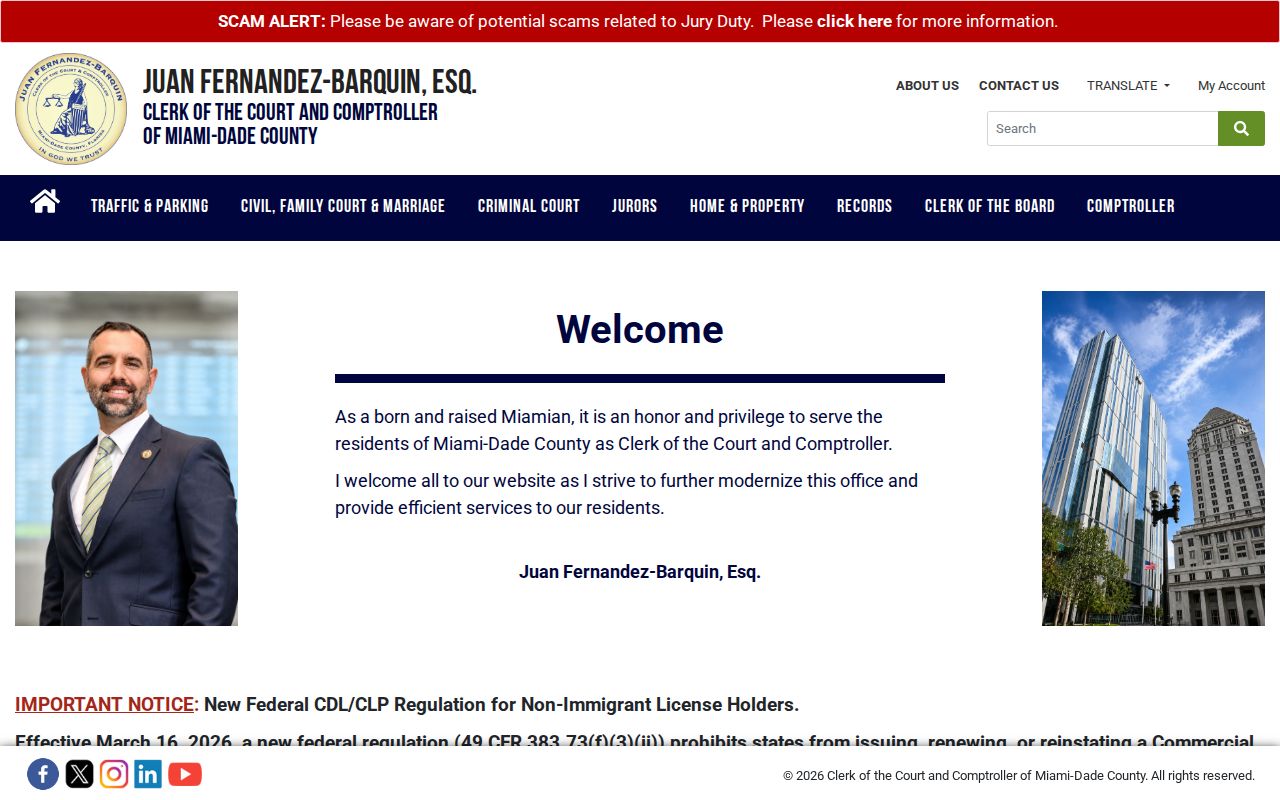
The screen is a starting point; the division holding the file remains the source for a certified result.
Hialeah Gardens Lookup Terms
A few record terms prevent mistakes when a resident lookup moves from a search screen to an official file. The distinction between a pointer and the underlying record matters most.
- Docket
- The court's dated list of filings, hearings, orders, and other events in a case.
- Index
- A searchable pointer showing names and record details. It may not include the document image.
- Image
- A scan or electronic copy of the filed document linked to an index entry when public.
- Certified copy
- A custodian-issued copy formally authenticated as a copy of its official record.
Capture the party role as well as the name. Plaintiff, defendant, petitioner, personal representative, grantor, and grantee mean different things. Status also matters. A dismissal, judgment, and pending case should never be described as the same outcome.
Confirm Hialeah Gardens Voter Data
Miami-Dade Voter Information asks for first name, last name, and date of birth. It returns the authenticated voter's address, political party, polling place, districts, sample ballot, mail-ballot status, and recent activity. Election activity states whether participation occurred, never how the person voted.
That self-service lookup is not a public block browser. Florida's public registration extract follows a separate process. The Division of Elections prepares a monthly disk for mail or pickup, and requests must include contact details and arrive before the scheduled publication. Custom or historical extracts may require a public-record request and administrative fees. Social Security numbers, driver or state ID numbers, signatures, and protected addresses are withheld under Florida law.
Note: Date each voter snapshot because registrations can change through moves, confirmation notices, and routine list maintenance.
Hialeah Gardens Vital Record Trails
Florida Vital Statistics offers certification, not a general free statewide name index. Birth records younger than 125 years are confidential and require an eligible requester, authorization, or court order. A death certificate without cause is public; cause of death remains restricted for 50 years. Marriage certificates and dissolution abstracts are public, while the Miami-Dade Clerk holds the original marriage license and full dissolution case.
The difference between an abstract and the full Clerk file is useful in a Hialeah Gardens resident lookup. A state abstract can confirm an event date and county. The Clerk file may hold the underlying local record, subject to closures and redactions. Direct applications can be mailed to the Bureau, submitted at its Jacksonville walk-in desk, or routed through Miami-Dade Health for qualifying local certificates. Calling 904-359-6900 can clarify forms and eligibility.
The direct base fees in the research are $9 for a first computer birth certificate and $5 for a first death, marriage, or dissolution search, with added-copy and handling charges. Recent marriage or dissolution events may take time to reach the state, making the Clerk the more direct custodian. Use the event record to confirm a relationship or date, not to force a match between names.
Florida Health's certificates and records gateway identifies the state application route for each event type.
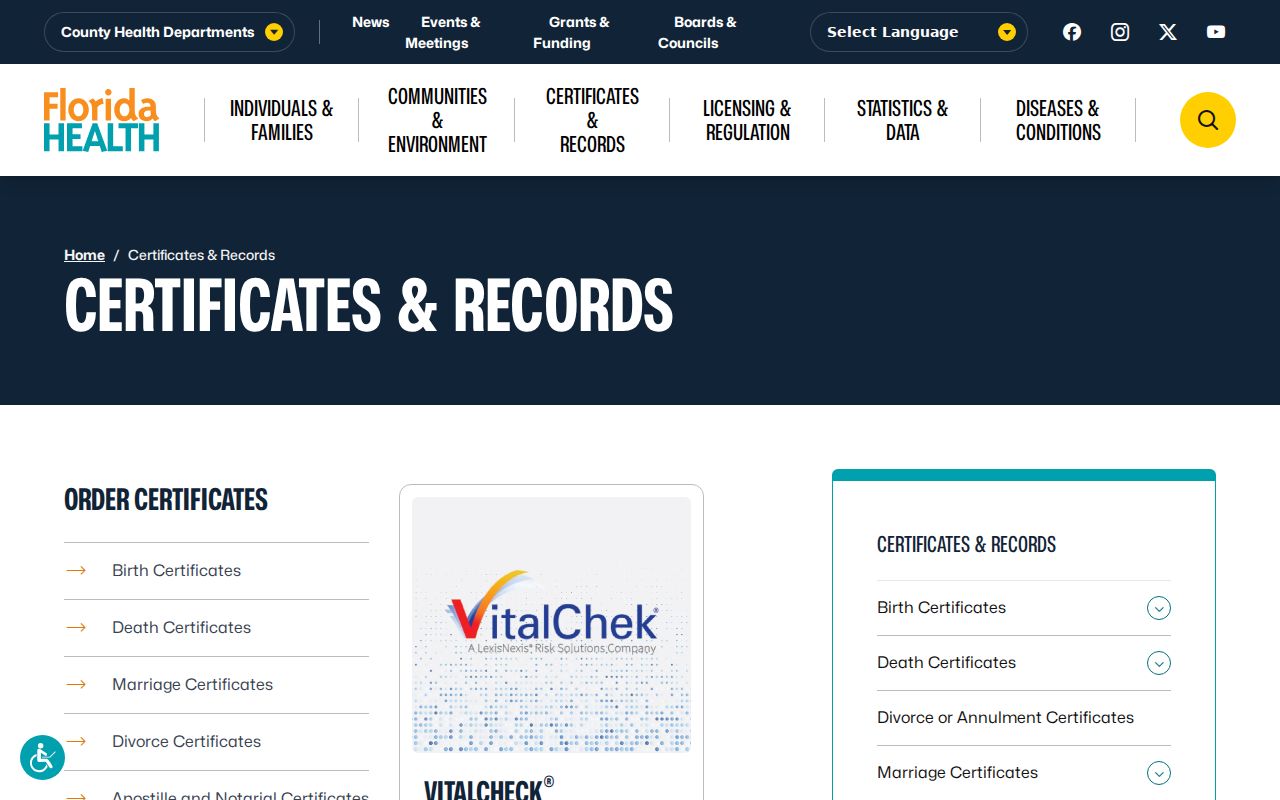
The record type chosen here determines the form, eligibility test, fee, and whether the Clerk may hold a fuller local file.
Check Hialeah Gardens Affiliations
Florida business and professional indexes add dated affiliations. Sunbiz supports entity name, officer or registered agent, document number, ZIP, and street-address searches. Annual-report images may show officer titles plus principal, mailing, and agent addresses. The Department of Business and Professional Regulation searches by name, license number, city or county, and license type. The MQA service covers health practitioners.
These sources help when a known trade, firm, or credential separates two people with the same name. They are weak as sole proof of residence. A registered-agent address may be an office, and a professional profile may use a business contact. Record the filing year or license status, then compare another dated source before reaching a conclusion.
Find Hialeah Gardens Heirs
Probate supplies a lawful human use for one-person research. Search the Miami-Dade court index by the decedent's name, then inspect public petitions and notices for a personal representative or named heirs. Match those roles against a deed, death certificate, or obituary clue. Public filing access varies, so the docket may point to a record that must be ordered from the Clerk.
For a birth-parent search, use Florida's official adoption and reunion procedures or a court-authorized route. Do not try to bypass sealed adoption records. Former classmates are better traced through yearbooks and library collections before current public records are used to verify a modern match. Each path respects the limits attached to the record.
Request Missing Hialeah Gardens Records
Not online does not mean closed. Florida Public Records Law, in article I, section 24 of the state constitution and chapter 119 of the statutes, provides a request route to the custodian. Name the record type, person or address, and a tight date span. Ask first for electronic inspection, then request the exemption citation and a redacted copy if part is withheld.
The fallback depends on record family. Pre-1974 recorded instruments move to the Clerk's Records Library and public computers. Court files go to the correct division for archived retrieval or certification. Vital records use the Bureau's DH form, mail, phone, or walk-in channels. A public voter extract goes through Elections. Historical directory or census work goes to MDPLS, archives, or library staff.
Hialeah Gardens Resident Lookup Limits
Florida does not offer a universal right to erase an accurate public record. It does protect defined data and people. The Attorney General's Address Confidentiality Program and protected-address classes in section 119.071 can hide a location. Voter signatures and key identity numbers are protected. Motor-vehicle personal data is restricted by state law and the federal DPPA. Qualifying people may also request redaction of Social Security or bank and card numbers from official-record images.
Commercial compilations can be stale or merge people who share a name. Their removal steps are service-specific and do not erase a government source. Find the privacy or removal page, provide only the least proof required, retain confirmation, and check later. Florida's Digital Bill of Rights applies only to narrowly defined large controllers, so it is not a universal deletion rule.
Lawful personal use. Use a Hialeah Gardens resident lookup for legitimate personal research. Never use public details to stalk, harass, threaten, or evade a protective measure.